Friedrich-Alexander-Universität Erlangen
Lehrstuhl für Mustererkennung
Martensstraße 3
91058 Erlangen

Projects

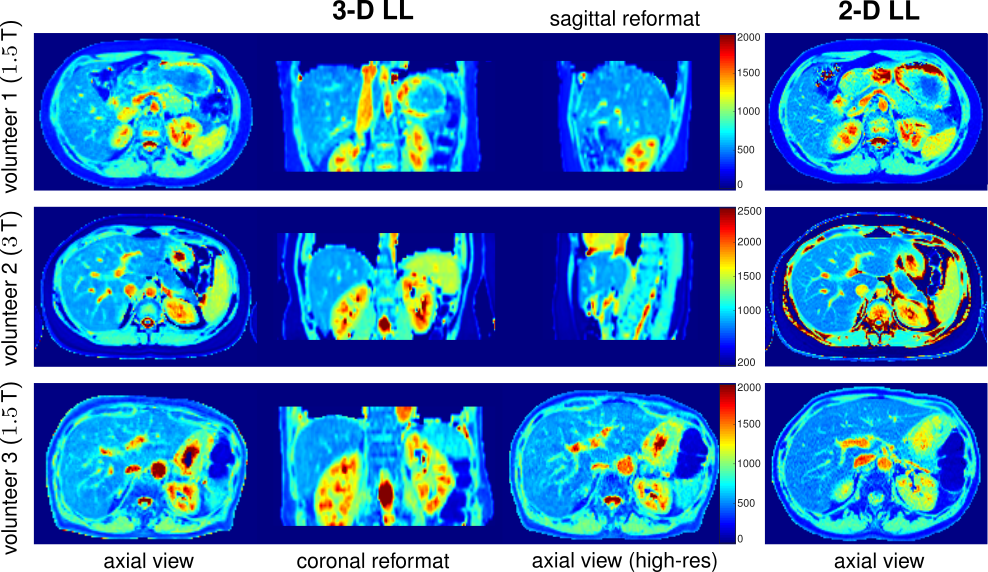
Abdominal T1 mapping can help diagnosing and staging hepatic diseases such as liver cirrhosis or pancreatitis. Yet, accurate methods that are based on sampling the relaxation curve are usually limited to a few slices in case of breathhold imaging. Common 3-D techniques are often based on variable flip angle (VFA) imaging, which is B1 sensitive, even when complemented with an additional B1 mapping acquisition and correction. Look-Locker (LL) sequences are considered more accurate albeit time-consuming, restricting 3-D LL to static scenes only.


In this project, we aim to achieve the volumetric coverage of VFA methods with the accuracy of LL-based methods in order to perform breath-held volumetric T1 mapping. To this end, we combine an accurate 3-D LL scheme based on k-space segmentation with sparse incoherent sampling in space and time.  A joint reconstruction of the 3-D+T data via compressed sensing exploits the spatio-temporal sparsity and ensures consistent quality for the subsequent multi-step T1 mapping. Data from the NIST phantom and 11 volunteers along with reference 2-D Look-Locker acquisitions are used for validation.

Journal Articles
Lugauer, Felix; Wetzl, Jens; Forman, Christoph; Schneider, Manuel; Kiefer, Berthold; Hornegger, Joachim; Nickel, Dominik; Maier, Andreas
Single-breath-hold abdominal T1 mapping using 3D Cartesian Look-Locker with spatiotemporal sparsity constraints
Magnetic Resonance Materials in Physics, Biology and Medicine, pp. 1-16, 2018 (BiBTeX, Who cited this?)
Articles in Conference Proceedings
Lugauer, Felix; Wetzl, Jens; Forman, Christoph; Schneider, Manuel; Kiefer, Berthold; Nickel, Dominik; Maier, Andreas
Single Breath-Hold Abdominal T1 Mapping Using 3-D Cartesian Sampling and Spatiotemporally Constrained Reconstruction
Proceedings of the 25th Annual Meeting of the ISMRM (ISMRM 2017), Honolulu, HI, USA, 22.-27.4.2017, pp. 68, 2017 (BiBTeX, Who cited this?)
Articles in Conference Proceedings
Wetzl, Jens; Schmidt, Michaela; Zenge, Michael O.; Lugauer, Felix; Lazar, Laszlo; Nadar, Mariappan; Maier, Andreas; Hornegger, Joachim; Forman, Christoph
Isotropic 3-D CINE Imaging with Sub-2mm Resolution in a Single Breath-Hold
Proceedings of the 23rd Annual Meeting of the ISMRM (ISMRM 2015) (23rd Annual Meeting of the ISMRM (ISMRM 2015)), Toronto, Canada, 30.5.-5.6.2015, pp. 1011, 2015 (BiBTeX, Who cited this?)

Only some small test text

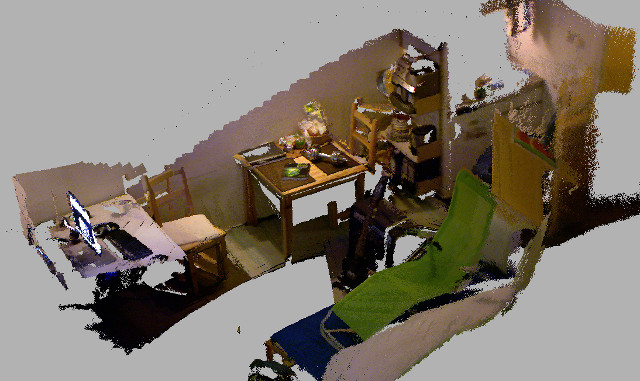
The reconstruction and modeling of three-dimensional scene geometry from temporal point cloud streams is of high interest for a variety of computer Vision applications. With the advent of RGB-D Imaging devices that deliver dense, metric and textured 6-D data in real-time, on-the-fly reconstruction of static Environments has come into reach.


We propose a system for real-time point cloud mapping and scene reconstruction based on an efficient implementation of the iterative closest point (ICP) algorithm on the graphics processing unit (GPU). Compared to recent state-of-the-art approaches that achieve real-time performance using projective ICP schemes that operate on the 3-D scene geometry solely, our method allows to incorporate additional complementary information to guide the reconstruction process. In this work, our nearest neighbor search evaluates both geometric and photometric information in a direct manner, in order to achieve robust mappings at real-time performance. For acceleration of the search space traversal, we exploit the inherent computing parallelism of GPUs. In particular, we have investigated the fitness of the random ball cover (RBC) data structure and search algorithm, originally proposed for high-dimensional problems, to low-dimensional data. In particular, we introduce a scheme that enables both fast RBC construction and queries. The proposed system is validated on indoor scene modeling and object reconstruction scenarios. For dense data from the Microsoft Kinect sensor (640x480 px), our implementation achieved frame-to-frame reconstruction runtimes of < 20 ms on an off-the-shelf consumer GPU.

Projects

Compressed Sensing for Single-Breath-hold Whole-liver T1 Mapping
PhD project in cooperation with Siemens Healthcare
  • Abdominal T1 mapping can help diagnosing and staging hepatic diseases such as liver cirrhosis or pancreatitis. Yet, accurate methods that are based on sampling the relaxation curve are usually limited to a few slices in case of breathhold imaging. Common 3-D techniques are often based on variable flip angle (VFA) imaging, which is B1 sensitive, even when complemented with an additional B1 mapping acquisition and correction. Look-Locker (LL) sequences are considered more accurate albeit time-consuming, restricting 3-D LL to static scenes only.


    In this project, we aim to achieve the volumetric coverage of VFA methods with the accuracy of LL-based methods in order to perform breath-held volumetric T1 mapping. To this end, we combine an accurate 3-D LL scheme based on k-space segmentation with sparse incoherent sampling in space and time.  A joint reconstruction of the 3-D+T data via compressed sensing exploits the spatio-temporal sparsity and ensures consistent quality for the subsequent multi-step T1 mapping. Data from the NIST phantom and 11 volunteers along with reference 2-D Look-Locker acquisitions are used for validation.

    Journal Articles
    Lugauer, Felix; Wetzl, Jens; Forman, Christoph; Schneider, Manuel; Kiefer, Berthold; Hornegger, Joachim; Nickel, Dominik; Maier, Andreas
    Single-breath-hold abdominal T1 mapping using 3D Cartesian Look-Locker with spatiotemporal sparsity constraints
    Magnetic Resonance Materials in Physics, Biology and Medicine, pp. 1-16, 2018 (BiBTeX, Who cited this?)
    Articles in Conference Proceedings
    Lugauer, Felix; Wetzl, Jens; Forman, Christoph; Schneider, Manuel; Kiefer, Berthold; Nickel, Dominik; Maier, Andreas
    Single Breath-Hold Abdominal T1 Mapping Using 3-D Cartesian Sampling and Spatiotemporally Constrained Reconstruction
    Proceedings of the 25th Annual Meeting of the ISMRM (ISMRM 2017), Honolulu, HI, USA, 22.-27.4.2017, pp. 68, 2017 (BiBTeX, Who cited this?)
Iterative Reconstruction Methods for Quantitative Abdominal Water-Fat MRI
PhD project in cooperation with Siemens Healthcare
  • Spectral sparsity of the acquired signal series

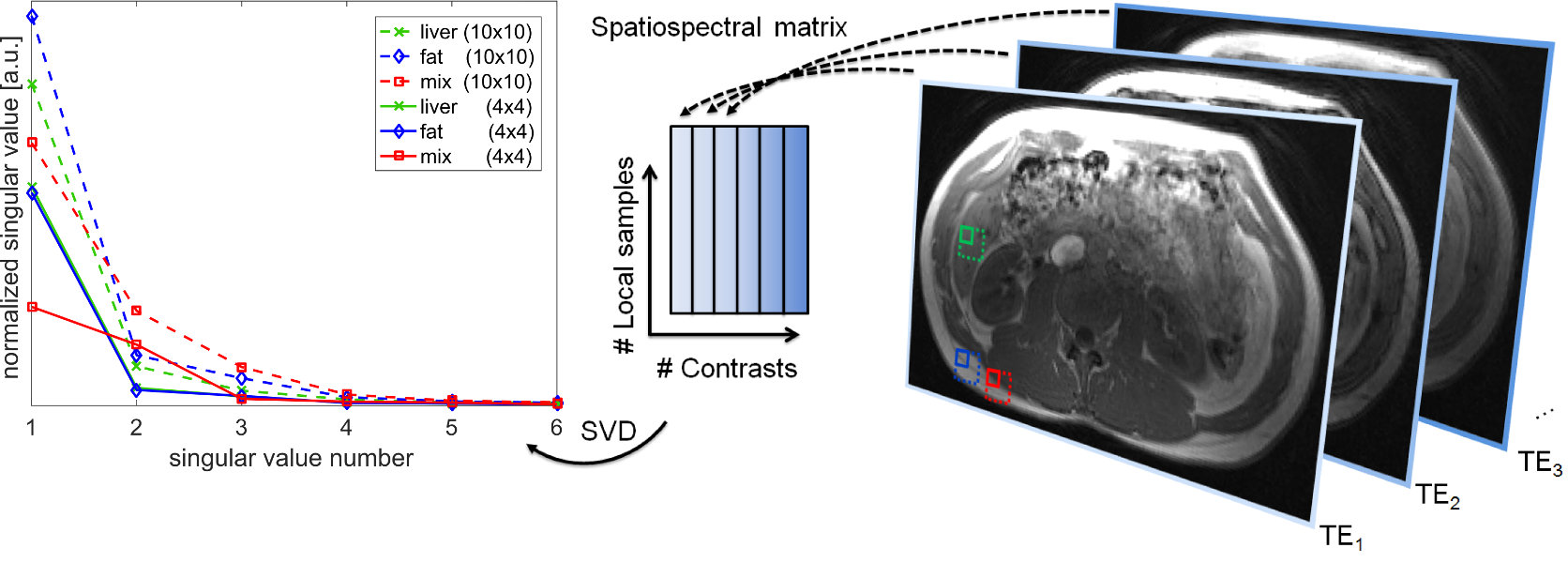
    The signal acquired from magnetic resonance imaging (MRI) is proportional to the density of hydrogen nuclei. The diagnostical value of a measurement can increase significantly when the signal from fat bound hydrogen nuclei is suppressed or exactly measured. Since fat-bound hydrogen nuclei have a slightly differing resonance frequency from those bound in water, they can be used for an exact determination of the signal spectrum. In recent years, this approach for signal separation gained increased interest since it enables both quantitative fat measurements and improved fat suppression compared to conventional methods. However, additional measurements, i.e. multiple echoes, are required causing a lengthened acquisition.


    Our aim is to reduce the acquisition time and enhance the image quality by iterative reconstruction techniques. For their applicability, a sparse signal representation is a key requirement. While a single measurement is usually not sparse prior to transformations, the images series that is needed to resolve various phase effects is spectrally sparse since it can be described by only two spectral components and said phase variations. Then, the  idea  is  to  promote  consistency  in  between  those measurements by  enforcing  a  representation  with  few  chemical components  but  without  having to know  the  spectral  properties of these components.


    This principle is exploited for robust spectral denoising, which enables an automated improvement of fat water quantification. Further, enforcing spectral instead of spatial sparsity during an iterative reconstruction makes sparser sampling and shorter scans possible.

    Journal Articles
    Lugauer, Felix; Nickel, Dominik; Wetzl, Jens; Kiefer, Berthold; Hornegger, Joachim; Maier, Andreas
    Accelerating Multi-Echo Water-Fat MRI with a Joint Locally Low-Rank and Spatial Sparsity-Promoting Reconstruction
    Magnetic Resonance Materials in Physics, Biology and Medicine, vol. -, pp. 01-14, 2016 (BiBTeX, Who cited this?)
    Articles in Conference Proceedings
    Lugauer, Felix; Nickel, Dominik; Kannengiesser, Stephan; Barnes, Samuel; Holshouser, Barbara; Wetzl, Jens; Hornegger, Joachim; Maier, Andreas
    Improving Parameter Mapping in MRI Relaxometry and Multi-Echo Dixon Using an Automated Spectral Denoising
    Proceedings of the 24th Annual Meeting of the ISMRM (ISMRM 2016) (24th Annual Meeting of the ISMRM (ISMRM 2016)), Singapur, 7.-13.5.2016, pp. 3269, 2016 (BiBTeX, Who cited this?)
    Allen, Brian; Lugauer, Felix; Nickel, Dominik; Bhatti, Lubna; Dafalla, Randa; Dale, Brian; Jaffe, Tracy; Bashir, Mustafa
    Effect of a Low-Rank Denoising Algorithm on Quantitative MRI-Based Measures of Liver Fat and Iron
    Proceedings of the 24th Annual Meeting of the ISMRM (ISMRM 2016) (24th Annual Meeting of the ISMRM (ISMRM 2016)), Singapur, 7.-13.5.2016, pp. 4224, 2016 (BiBTeX, Who cited this?)
    Lugauer, Felix; Nickel, Dominik; Wetzl, Jens; Kiefer, Berthold; Hornegger, Joachim
    Water-Fat Separation Using a Locally Low-Rank Enforcing Reconstruction
    Proceedings of the 23rd Annual Meeting of the ISMRM (ISMRM 2015) (23rd Annual Meeting of the ISMRM (ISMRM 2015)), Toronto, ON, Canada, 30.5-5.6.2015, pp. 3652, 2015 (BiBTeX, Who cited this?)
    Lugauer, Felix; Nickel, Dominik; Wetzl, Jens; Kannengiesser, Stephan A. R.; Maier, Andreas; Hornegger, Joachim
    Robust Spectral Denoising for Water-Fat Separation in Magnetic Resonance Imaging
    Medical Image Computing and Computer-Assisted Intervention (MICCAI 2015), Munich, Germany, 05.10.2015, pp. 667-674, 2015, ISBN 978-3-319-24570-6 (BiBTeX, Who cited this?)
Spectral sparsity of the acquired signal series

The signal acquired from magnetic resonance imaging (MRI) is proportional to the density of hydrogen nuclei. The diagnostical value of a measurement can increase significantly when the signal from fat bound hydrogen nuclei is suppressed or exactly measured. Since fat-bound hydrogen nuclei have a slightly differing resonance frequency from those bound in water, they can be used for an exact determination of the signal spectrum. In recent years, this approach for signal separation gained increased interest since it enables both quantitative fat measurements and improved fat suppression compared to conventional methods. However, additional measurements, i.e. multiple echoes, are required causing a lengthened acquisition.


Our aim is to reduce the acquisition time and enhance the image quality by iterative reconstruction techniques. For their applicability, a sparse signal representation is a key requirement. While a single measurement is usually not sparse prior to transformations, the images series that is needed to resolve various phase effects is spectrally sparse since it can be described by only two spectral components and said phase variations. Then, the  idea  is  to  promote  consistency  in  between  those measurements by  enforcing  a  representation  with  few  chemical components  but  without  having to know  the  spectral  properties of these components.


This principle is exploited for robust spectral denoising, which enables an automated improvement of fat water quantification. Further, enforcing spectral instead of spatial sparsity during an iterative reconstruction makes sparser sampling and shorter scans possible.

Finished Projects

Journal Articles
Lugauer, Felix; Nickel, Dominik; Wetzl, Jens; Kiefer, Berthold; Hornegger, Joachim; Maier, Andreas
Accelerating Multi-Echo Water-Fat MRI with a Joint Locally Low-Rank and Spatial Sparsity-Promoting Reconstruction
Magnetic Resonance Materials in Physics, Biology and Medicine, vol. -, pp. 01-14, 2016 (BiBTeX, Who cited this?)
Articles in Conference Proceedings
Lugauer, Felix; Nickel, Dominik; Kannengiesser, Stephan; Barnes, Samuel; Holshouser, Barbara; Wetzl, Jens; Hornegger, Joachim; Maier, Andreas
Improving Parameter Mapping in MRI Relaxometry and Multi-Echo Dixon Using an Automated Spectral Denoising
Proceedings of the 24th Annual Meeting of the ISMRM (ISMRM 2016) (24th Annual Meeting of the ISMRM (ISMRM 2016)), Singapur, 7.-13.5.2016, pp. 3269, 2016 (BiBTeX, Who cited this?)
Allen, Brian; Lugauer, Felix; Nickel, Dominik; Bhatti, Lubna; Dafalla, Randa; Dale, Brian; Jaffe, Tracy; Bashir, Mustafa
Effect of a Low-Rank Denoising Algorithm on Quantitative MRI-Based Measures of Liver Fat and Iron
Proceedings of the 24th Annual Meeting of the ISMRM (ISMRM 2016) (24th Annual Meeting of the ISMRM (ISMRM 2016)), Singapur, 7.-13.5.2016, pp. 4224, 2016 (BiBTeX, Who cited this?)
Lugauer, Felix; Nickel, Dominik; Wetzl, Jens; Kiefer, Berthold; Hornegger, Joachim
Water-Fat Separation Using a Locally Low-Rank Enforcing Reconstruction
Proceedings of the 23rd Annual Meeting of the ISMRM (ISMRM 2015) (23rd Annual Meeting of the ISMRM (ISMRM 2015)), Toronto, ON, Canada, 30.5-5.6.2015, pp. 3652, 2015 (BiBTeX, Who cited this?)
Lugauer, Felix; Nickel, Dominik; Wetzl, Jens; Kannengiesser, Stephan A. R.; Maier, Andreas; Hornegger, Joachim
Robust Spectral Denoising for Water-Fat Separation in Magnetic Resonance Imaging
Medical Image Computing and Computer-Assisted Intervention (MICCAI 2015), Munich, Germany, 05.10.2015, pp. 667-674, 2015, ISBN 978-3-319-24570-6 (BiBTeX, Who cited this?)
Lumen Segmentation of Coronary Arteries in CT Angiography
Master's thesis in cooperation with Siemens AG, Corporate Technology
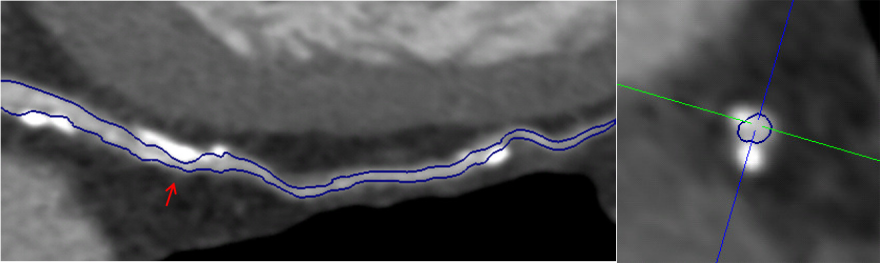
  • Invasive cardiac angiography (catheterization) is still the standard in clinical practice for diagnosing coronary artery disease (CAD) but it involves a high amount of risk and cost. New generations of CT scanners can acquire high-quality Images of coronary arteries which allow for an accurate identification and delineation of stenoses. Recently, computational flow Dynamics simulation has been applied to coronary blood flow using geometric lumen models extracted from CT angiography (CTA). The computed pressure drop at stenoses proved to be indicative for ischemia-causing lesions, leading to non-invasive Fractional Flow Reserve derived from CTA. Since the diagnostic value of non-invasive procedures for diagnosing CAD relies on an accurate extraction of the lumen, a precise segmentation of the coronary arteries is crucial. As manual segmentation is tedious, time-consuming and subjective, automatic procedures are desirable.


    We present a novel fully-automatic method to accurately segment the lumen of coronary arteries in the presence of calcified and noncalcified plaque. Our segmentation framework is based on three main steps: boundary detection, calcium exclusion and surface optimization. A learning-based boundary detector enables a robust lumen contour detection via dense ray-casting. The exclusion of calcified plaque is assured through a novel calcium exclusion technique which allows us to accurately capture stenoses of diseased arteries. The boundary detection results are incorporated into a closed set formulation whose minimization yields an optimized lumen surface. On standardized tests with clinical data, a segmentation accuracy is achieved which is comparable to clinical experts and superior to current automatic methods.

    Articles in Conference Proceedings
    Lugauer, Felix; Zhang, Jingdan; Zheng, Yefeng; Hornegger, Joachim; Kelm, Michael
    Improving Accuracy in Coronary Lumen Segmentation via Explicit Calcium Exclusion, Learning-based Ray Detection and Surface Optimization
    Proceedings SPIE (Medical Imaging 2014: Image Processing), San Diego, California, USA, 15.02.2014, vol. 9034, pp. 90343U-10, 2014 (BiBTeX, Who cited this?)
    Lugauer, Felix; Zheng, Yefeng; Hornegger, Joachim; Kelm, B. Michael
    Precise Lumen Segmentation in Coronary Computed Tomography Angiography
    Medical Computer Vision: Algorithms for Big Data (International Workshop, MCV 2014, Held in Conjunction with MICCAI 2014), Cambridge, MA, USA, 18.09.2014, pp. 137-147, 2014, ISBN 978-3-319-13971-5 (BiBTeX, Who cited this?)

Invasive cardiac angiography (catheterization) is still the standard in clinical practice for diagnosing coronary artery disease (CAD) but it involves a high amount of risk and cost. New generations of CT scanners can acquire high-quality Images of coronary arteries which allow for an accurate identification and delineation of stenoses. Recently, computational flow Dynamics simulation has been applied to coronary blood flow using geometric lumen models extracted from CT angiography (CTA). The computed pressure drop at stenoses proved to be indicative for ischemia-causing lesions, leading to non-invasive Fractional Flow Reserve derived from CTA. Since the diagnostic value of non-invasive procedures for diagnosing CAD relies on an accurate extraction of the lumen, a precise segmentation of the coronary arteries is crucial. As manual segmentation is tedious, time-consuming and subjective, automatic procedures are desirable.


We present a novel fully-automatic method to accurately segment the lumen of coronary arteries in the presence of calcified and noncalcified plaque. Our segmentation framework is based on three main steps: boundary detection, calcium exclusion and surface optimization. A learning-based boundary detector enables a robust lumen contour detection via dense ray-casting. The exclusion of calcified plaque is assured through a novel calcium exclusion technique which allows us to accurately capture stenoses of diseased arteries. The boundary detection results are incorporated into a closed set formulation whose minimization yields an optimized lumen surface. On standardized tests with clinical data, a segmentation accuracy is achieved which is comparable to clinical experts and superior to current automatic methods.

Monographs (article)
Bauer, Sebastian; Wasza, Jakob; Lugauer, Felix; Neumann, Dominik; Hornegger, Joachim
Real-Time RGB-D Mapping and 3-D Modeling on the GPU Using the Random Ball Cover
Consumer Depth Cameras for Computer Vision - Research Topics and Applications Advances in Computer Vision and Pattern Recognition, Springer London, UK, 2013, 27-48 (BiBTeX, Who cited this?)
Articles in Conference Proceedings
Neumann, Dominik; Lugauer, Felix; Bauer, Sebastian; Wasza, Jakob; Hornegger, Joachim
Real-time RGB-D Mapping and 3-D Modeling on the GPU using the Random Ball Cover Data Structure
IEEE International Conference on Computer Vision (ICCV) Workshops (IEEE Workshop on Consumer Depth Cameras for Computer Vision (CDC4CV)), Barcelona, Spain, 12.11.2011, pp. 1161-1167, 2011 (BiBTeX, Who cited this?)
Real-time RGB-D Mapping and 3-D Modeling on the GPU using the Random Ball Cover Data Structure
  • The reconstruction and modeling of three-dimensional scene geometry from temporal point cloud streams is of high interest for a variety of computer Vision applications. With the advent of RGB-D Imaging devices that deliver dense, metric and textured 6-D data in real-time, on-the-fly reconstruction of static Environments has come into reach.


    We propose a system for real-time point cloud mapping and scene reconstruction based on an efficient implementation of the iterative closest point (ICP) algorithm on the graphics processing unit (GPU). Compared to recent state-of-the-art approaches that achieve real-time performance using projective ICP schemes that operate on the 3-D scene geometry solely, our method allows to incorporate additional complementary information to guide the reconstruction process. In this work, our nearest neighbor search evaluates both geometric and photometric information in a direct manner, in order to achieve robust mappings at real-time performance. For acceleration of the search space traversal, we exploit the inherent computing parallelism of GPUs. In particular, we have investigated the fitness of the random ball cover (RBC) data structure and search algorithm, originally proposed for high-dimensional problems, to low-dimensional data. In particular, we introduce a scheme that enables both fast RBC construction and queries. The proposed system is validated on indoor scene modeling and object reconstruction scenarios. For dense data from the Microsoft Kinect sensor (640x480 px), our implementation achieved frame-to-frame reconstruction runtimes of < 20 ms on an off-the-shelf consumer GPU.

    Monographs (article)
    Bauer, Sebastian; Wasza, Jakob; Lugauer, Felix; Neumann, Dominik; Hornegger, Joachim
    Real-Time RGB-D Mapping and 3-D Modeling on the GPU Using the Random Ball Cover
    Consumer Depth Cameras for Computer Vision - Research Topics and Applications Advances in Computer Vision and Pattern Recognition, Springer London, UK, 2013, 27-48 (BiBTeX, Who cited this?)
    Articles in Conference Proceedings
    Neumann, Dominik; Lugauer, Felix; Bauer, Sebastian; Wasza, Jakob; Hornegger, Joachim
    Real-time RGB-D Mapping and 3-D Modeling on the GPU using the Random Ball Cover Data Structure
    IEEE International Conference on Computer Vision (ICCV) Workshops (IEEE Workshop on Consumer Depth Cameras for Computer Vision (CDC4CV)), Barcelona, Spain, 12.11.2011, pp. 1161-1167, 2011 (BiBTeX, Who cited this?)
Articles in Conference Proceedings
Lugauer, Felix; Zhang, Jingdan; Zheng, Yefeng; Hornegger, Joachim; Kelm, Michael
Improving Accuracy in Coronary Lumen Segmentation via Explicit Calcium Exclusion, Learning-based Ray Detection and Surface Optimization
Proceedings SPIE (Medical Imaging 2014: Image Processing), San Diego, California, USA, 15.02.2014, vol. 9034, pp. 90343U-10, 2014 (BiBTeX, Who cited this?)
Lugauer, Felix; Zheng, Yefeng; Hornegger, Joachim; Kelm, B. Michael
Precise Lumen Segmentation in Coronary Computed Tomography Angiography
Medical Computer Vision: Algorithms for Big Data (International Workshop, MCV 2014, Held in Conjunction with MICCAI 2014), Cambridge, MA, USA, 18.09.2014, pp. 137-147, 2014, ISBN 978-3-319-13971-5 (BiBTeX, Who cited this?)